On a pickleball court, the action can look deceptively simple.
A serve. A return. A quick exchange at the net.
Then another.
And another.
But beyond the steady pop of the plastic ball against the paddle is a bigger story—one about how a sport that was once unfamiliar to most Filipinos has found an unexpected home in the country.
Pickleball courts are becoming increasingly common in malls, sports facilities, schools and communities. Players gather before work, after office hours and on weekends. Some come for exercise. Others come for competition. Many simply come because their friends are there.
Whatever the reason, the result is the same: more Filipinos are playing pickleball.
And the growth has been remarkable.
From a few enthusiasts to thousands of players
Pickleball did not arrive in the Philippines with the fanfare usually associated with a new major sport.
The Philippine Pickleball Federation traces the country’s early pickleball activity to a clinic in Cebu in 2016. Small groups eventually formed, including a community in Ortigas, Pasig, where players began holding Saturday evening games on the streets in 2018.
The beginnings were modest.
But the community kept growing.
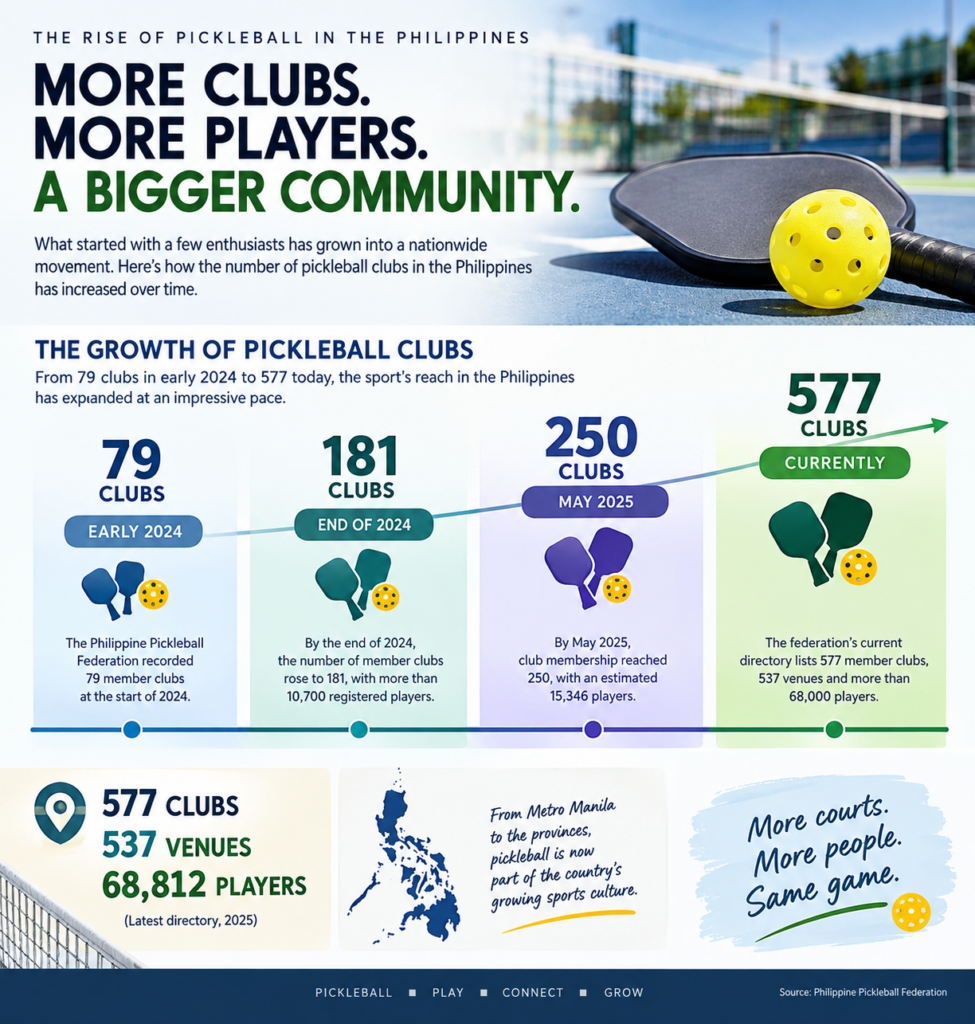
The federation recorded 79 clubs at the start of 2024. By the end of that year, it had 181 member clubs and 10,717 players. By May 2025, membership had reached 250 clubs, with an estimated 15,346 players.
The federation’s current directory lists 577 member clubs, 537 venues and 68,812 players, reflecting how far the sport has spread across the country.
For a sport that was barely on the radar of most Filipinos a decade ago, the numbers tell a striking story.
Easy to pick up, hard to put down
Part of pickleball’s appeal is its accessibility.
The sport borrows elements from tennis, badminton and table tennis. Players use solid paddles and a perforated plastic ball on a court smaller than a tennis court.
For beginners, that can make the first few games less intimidating.
You don’t have to be a longtime athlete to pick up a paddle and start learning.
But the sport can become considerably more challenging as players improve. Placement, timing, footwork and strategy become increasingly important, particularly in competitive play.
The combination is easy enough for a newcomer to try, but challenging enough to keep experienced players interested and it has helped give pickleball a broad appeal.
Then there is the social side.
In many Filipino communities, sports are rarely just about the game. They are also about the people around it.
A court becomes a meeting place. A doubles partner becomes a friend. A casual Saturday game can turn into a regular weekly routine.
For many players, that sense of community is as important as the score.
When the malls joined the Pickleball craze

The growth eventually caught the attention of major businesses.
Pickleball courts began appearing in commercial sports facilities and shopping malls, bringing the sport closer to people who might never have encountered it otherwise.
In 2025, SM Supermalls launched its SM Active Hub, featuring 44 pickleball courts across 21 malls nationwide, according to the Philippine Pickleball Federation. New courts were also being developed in different parts of the country.
The expansion changed the visibility of the sport.
Instead of having to search for a small community court or know someone who already played, Filipinos could increasingly encounter pickleball while doing something as ordinary as going to the mall.
That accessibility matters.
Sports grow when people can see them, try them and find other people to play with.
From recreation to competition
Pickleball’s growth has also been accompanied by the development of a formal competitive structure.
In April 2024, the Philippine Olympic Committee formally welcomed the Philippine Pickleball Federation as the country’s National Sports Association for pickleball. At the time, the federation had 89 member clubs and more than 4,300 players.
National competitions have since become part of the growing calendar.

In June 2025, the first official PPF National Championship featured more than 650 games over three days.
And Filipino players are beginning to gain attention outside the country.
At the 2025 World Pickleball Championships Asia Grand Slam in China, Team Philippines won one gold, one silver and five bronze medals in a tournament that attracted more than 800 players from 20 countries.
That competitive pathway gives the sport another dimension.
For some, pickleball remains a weekend pastime.
For others, it is becoming a serious athletic pursuit.
Is Pickleball fad or a new fixture?
The question now is whether pickleball’s rapid rise will last.
Sports trends come and go. Popularity alone does not guarantee longevity.
But pickleball is no longer simply a curiosity being introduced to Filipinos. It now has organized clubs, dedicated facilities, a national governing body, competitive events and an expanding player base.
Those foundations could help determine whether the current boom develops into a lasting part of Philippine sports.
For now, the transformation is happening one court at a time.
A sport that began with a small number of enthusiasts has reached communities across the country. What was once an unfamiliar word is now part of conversations among friends, families, athletes and sports enthusiasts.
And somewhere on a court, another beginner is probably holding a paddle for the first time, watching the ball come toward them.
They swing.
Pop.
The game begins.
And just like that, another Filipino becomes a pickler.
Read more:
Threads of Perseverance: The Story of Gaor Manila’s success – GoDyaryo
From Garage to Malls: The Faith Journey of Sarah’s Bakehouse – GoDyaryo